Upgrading your golf cart to lithium batteries can reduce weight, eliminate battery watering, and provide more consistent performance throughout your ride. But a successful conversion takes more than replacing the batteries with the right voltage.
The right lithium battery must match your cart’s voltage, provide enough current for both everyday driving and short bursts of acceleration, and store enough energy for the distance you want to travel. Your charger, battery mounting, and accessories also need to work with the new system.
This guide explains what to check before buying and how to plan a reliable golf cart lithium battery conversion.
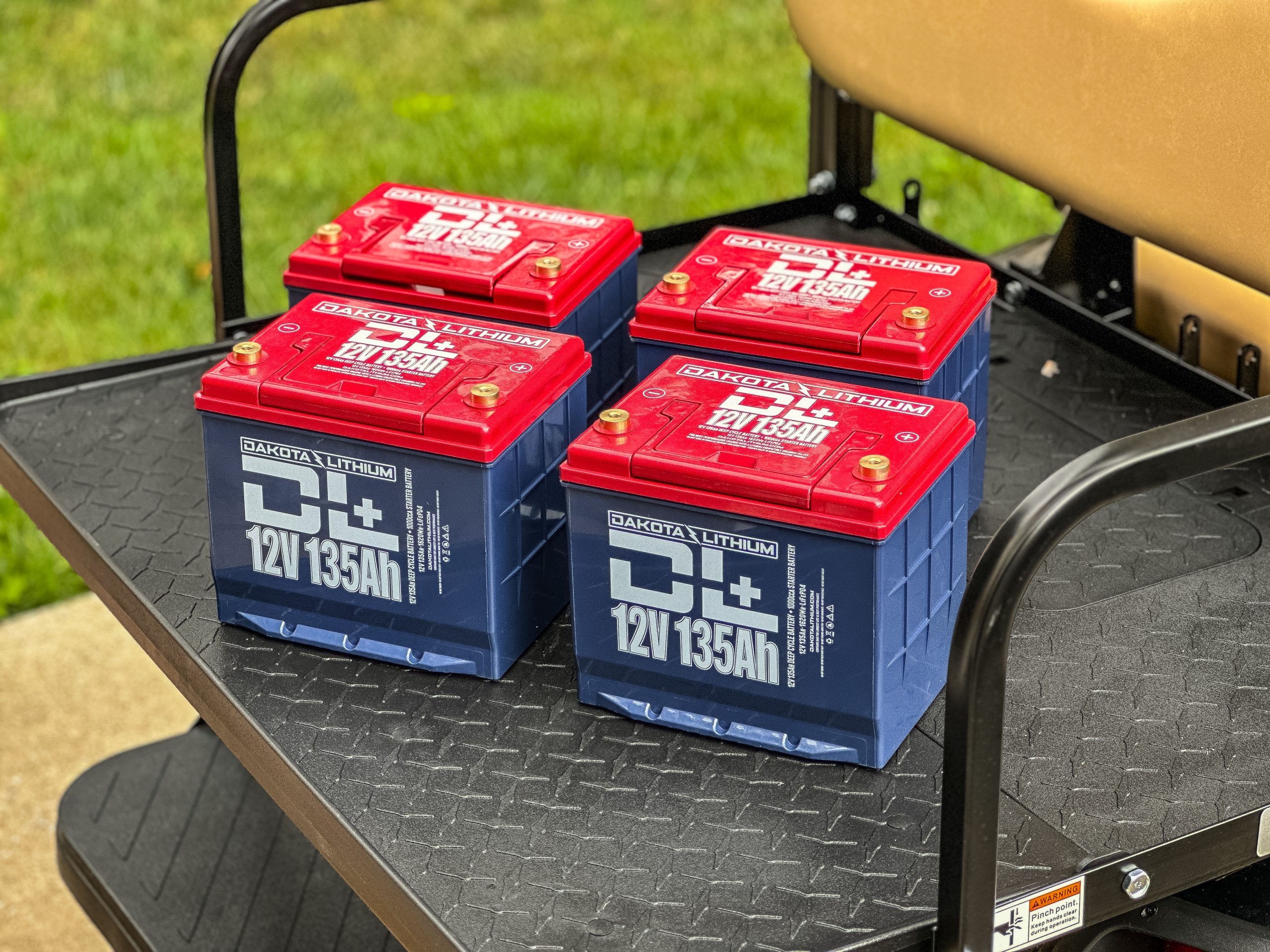
Why Upgrade Your Golf Cart to Lithium Batteries?
Lithium iron phosphate (LiFePO4) batteries offer lots of advantages over the flooded lead-acid batteries commonly used in electric golf carts.
Less Weight to Carry
A lithium battery system can weigh substantially less than the lead-acid bank it replaces. The actual savings depend on the batteries and capacity you choose, but like-for-like energy will typically reduce your cart’s battery weight by 60 to 70%. Removing that weight reduces the load your cart carries, improving overall handling, range, efficiency, and performance, like better acceleration.
No Battery Watering
LiFePO4 batteries do not need electrolyte checks or regular watering. You should still inspect cables, terminals, and mounting hardware, but routine battery care becomes simpler.
More Consistent Performance
Lead-acid battery voltage falls as the batteries discharge and can sag noticeably under heavy loads. LiFePO4 batteries maintain a steadier voltage through much of their discharge, helping your cart deliver more consistent performance as you use the battery.
More Usable Energy
Lithium batteries can generally use a greater portion of their rated capacity without the same cycle-life penalty associated with routinely deep-discharging lead-acid batteries. Lead-acid batteries also deliver less usable capacity at higher discharge rates, like hard accelerations and high speeds.
That can make lithium a practical way to increase range, but there is no universal rule that a 100Ah lithium battery replaces a 200Ah lead-acid bank. Compare systems at the same voltage and account for driving conditions, battery condition, and usable energy.
Long Service Life and Flexible Charging
LiFePO4 batteries can provide a long cycle life when operated within their specifications, typically lasting 4 to 5x longer than lead-acid. They can also accept relatively high charging currents when paired with suitable charging equipment, allowing much quicker and more efficient charging.
Actual charging time depends on battery capacity, how much energy you used, and the charger’s output. A lithium conversion does not automatically charge faster if you continue using a low-output charger.
Shop Golf Cart Batteries
Step 1: Confirm Your Golf Cart’s Voltage
Start with the cart’s owner’s manual, identification label, or manufacturer specifications. Many electric golf carts use a 36V or 48V system, although other voltages exist.
You can also check the voltage labels on the existing batteries and confirm how they are connected. In a single series-connected bank, the battery voltages add together.
|
Existing lead-acid configuration
|
System voltage
|
|
Six 6V batteries in series
|
36V
|
|
Six 8V batteries in series
|
48V
|
|
Eight 6V batteries in series
|
48V
|
|
Four 12V batteries in series
|
48V
|
Do not determine voltage from battery count alone. Six batteries could form either a 36V or 48V bank, depending on their individual voltage.
Choose a lithium system designed for your cart’s existing voltage class. A 36V cart needs a compatible 36V replacement system; a 48V cart needs a compatible 48V replacement system.
Lithium products may list a nominal voltage that differs slightly from the cart’s voltage class. Compatibility depends on the battery’s full operating voltage range, including its fully charged voltage, and what the controller and other components support.
Installing a battery at a different voltage than the cart was originally designed for can cause a malfunction or permanent damage. Increasing the voltage for higher performance usually requires additional component changes to function properly.
Step 2: Check How Much Current Your Cart Requires
Voltage is only part of compatibility. Your battery must also supply the current your cart needs without exceeding its output limits.
A cart driving on level pavement may draw much less current than the same cart accelerating uphill with several passengers. Larger tires, added cargo, and upgraded motors or controllers can also increase demand.
Check two battery specifications:
-
Continuous discharge current: The current the battery can supply on an ongoing basis under its specified operating conditions.
-
Surge or peak discharge current: A higher current the battery can supply for a limited time.
Both ratings matter. A high surge rating does not mean the battery can deliver that current continuously.
Understand What the Motor Controller Rating Means
The motor controller regulates power delivered to the motor in response to the accelerator and its programmed settings.
A controller advertised as “400A” does not mean the cart continuously draws 400 amps. It also does not necessarily mean the battery need 400 amps: some controller ratings describe motor-side or phase current, which can differ from battery-side current.
Use the controller documentation or ask the cart manufacturer or installer to identify the relevant battery current limit, along with the expected sustained demand.
Match short battery-side current peaks to the battery’s surge capability, including the allowed duration. Sustained draw must remain within the battery’s continuous rating. If the controller can demand high current for longer than the battery’s surge window, that combination needs further evaluation.
Surge Duration Matters
For example, consider a hypothetical battery rated for:
A brief 250A acceleration demand might fit those limits. A sustained 200A hill climb would exceed the continuous rating, even though it remains below the advertised 300A surge number.
These are illustrative numbers; our 48V Golf cart battery can sustain 200A continuous and has a 300A 30-second pulse current capability. These numbers are adequate for most golf carts unless they have extreme motor and controller modifications.
Why an Undersized Battery Can Shut the Cart Down
Lithium batteries use a battery management system, or BMS, to monitor operating conditions and protect the battery. If the cart exceeds the battery’s current limits, the BMS may disconnect output.
The cart can lose propulsion unexpectedly even when the battery still has charge remaining. Depending on the battery and the fault, restoring operation may require removing the load or following a specified reset procedure.
Choose a battery with adequate operating margin for your actual use. Do not rely on BMS shutdown as a normal way to limit current, and do not use a starter battery’s cold cranking amp rating as a substitute for checking continuous and surge discharge specifications.

Step 3: Choose a Single Battery or a Series-Connected Bank
There are two common ways to build a lithium replacement system: use one battery designed for the cart’s voltage, or connect compatible lower-voltage batteries in series.
Our Recommendation: One or Two Correctly Sized 36V or 48V Battery
For most conversions, we recommend starting with a single or double 36V or 48V lithium battery designed for golf cart use, provided it meets the cart’s current, capacity, and fit requirements.
A single battery simplifies installation by reducing the number of interconnecting cables and terminals. It also avoids the need to manage the balance between separate batteries in a series bank.
However, matching voltage alone is not enough. A battery intended for a lower-current application may not support a golf cart’s acceleration or hill-climbing demands.
Using 12V Lithium Batteries in Series
Compatible 12V-class lithium batteries can also form a higher-voltage system:
|
Configuration
|
Resulting system voltage class
|
|
Three approved 12V batteries in series
|
36V
|
|
Four approved 12V batteries in series
|
48V
|
Only use batteries explicitly approved by their manufacturer for the intended series configuration. Follow the instructions for matching batteries, initial charging, and ongoing balancing.
Connecting batteries in series increases voltage—not amp-hour capacity or current capability.
For example, four identical 12V 135Ah batteries connected in series form a 48V-class, 135Ah bank. They do not form a 540Ah bank. If each battery is rated for 100A continuous discharge, the series bank remains limited to 100A continuous because the same current flows through every battery.
The higher voltage increases the bank’s total stored energy and the power available at a given current, but it does not increase the allowable amps.
What About Parallel Connections?
Parallel connections keep voltage the same while adding amp-hour capacity. They can also increase available current when the batteries are approved for parallel operation, and the system is properly designed.
Current sharing depends on the batteries, wiring, and connections. Follow the manufacturer’s limits rather than assuming any two batteries can be connected together or that the bank will always deliver exactly twice one battery’s rated current.

Step 4: Choose Enough Capacity for Your Driving
Your existing lead-acid battery bank is a useful starting point for choosing lithium capacity. If it provided enough range when healthy, you can use its ratings to help size the replacement.
First, find the amp-hour (Ah) rating on a battery label or manufacturer specification sheet. In a series-connected bank, voltage adds together, but amp-hour capacity stays the same.
For example, these hypothetical lead-acid banks all provide the same nominal voltage and capacity:
|
Existing battery bank
|
Total bank rating
|
|
Four 12V 150Ah batteries in series
|
48V, 150Ah
|
|
Six 8V 150Ah batteries in series
|
48V, 150Ah
|
|
Eight 6V 150Ah batteries in series
|
48V, 150Ah
|
Actual golf cart battery capacities vary, so check your batteries rather than estimating from their number or size.
Do You Need the Same Amp-Hours in Lithium?
Not necessarily. A lithium battery can often provide comparable range with fewer rated amp-hours, because more of its stored energy is practically usable and its capacity is less affected by the high current demands of driving. The lighter weight will also make the cart more efficient.
However, there is no universal “half the amp-hours” replacement rule. Lead-acid batteries can discharge beyond 50%; doing so regularly generally shortens their service life. Their available capacity also depends on discharge rate, age, temperature, and condition.
For example, if you normally used about half the capacity of a healthy 48V 200Ah lead-acid bank, a 48V-class 100Ah lithium battery would be a starting point for comparison, but it would leave little reserve if you needed nearly its full capacity for every trip. A larger lithium battery would provide more margin.
If you regularly used most of the old bank’s available range, do not assume a lithium battery with half the Ah rating will cover the same distance. Choosing similar Ah capacity at 75% to 100% of the same voltage is a more conservative starting point for maintaining or improving range.
Compare Against Your Cart’s Normal Use
Before choosing capacity, consider:
-
Range when the old batteries were healthy: Worn-out batteries are a poor benchmark for the original system’s capability.
-
How much farther you want to drive: Choose additional capacity if your previous range was limiting.
-
Your typical load and terrain: Passengers, cargo, hills, larger tires, and higher speeds all affect energy use.
-
A reserve for longer trips: Avoid sizing the battery so a normal outing routinely leaves it nearly empty.

Step 5: Check the Charger, Accessories, and Installation Requirements
A lithium conversion may require more than the battery itself. Review these items before removing the old bank.
A Compatible Lithium Charger
Use a charger approved for the battery’s chemistry, voltage, and charging-current limits.
An existing lead-acid charger is not automatically compatible just because its label says 36V or 48V. Its charging profile, equalization functions, and shutoff behavior may be unsuitable.
Some cart charging systems also involve an onboard computer or charging interlock. Follow model-specific conversion instructions to preserve the required safety functions.
⚡️ Pro Tip: Learn how to charge LiFePO4 lithium batteries the right way!
A Suitable Battery Meter
A voltage-based lead-acid charge indicator will not accurately show remaining charge after a lithium conversion because LiFePO4 has a flatter discharge curve.
Use the battery’s supported monitoring system or a compatible battery monitor that tracks energy use and state of charge. Our 48V golf cart battery includes a battery meter that you can mount in the golf cart.

Power for 12V Accessories
Check how headlights, stereos, and other accessories receive power.
If they were previously connected to part of the lead-acid bank, plan to supply them through a properly sized DC-DC converter that takes power from the full lithium bank and provides the required accessory voltage.
Do not tap one battery in a lithium series bank to run 12V accessories. Uneven discharge can cause imbalance between the batteries.
Secure Mounting and Appropriate Wiring
Measure the available space and check terminal clearance before ordering. A smaller battery still needs a mounting system that prevents movement over bumps and turns.
Have the cables, connectors, and overcurrent protection checked for the new system’s voltage and current requirements. A battery’s internal BMS does not replace properly selected external circuit protection.
Regenerative Braking Compatibility
If your cart uses regenerative braking, confirm that the battery and controller are compatible with the charging current and voltage produced during braking.
This is especially relevant when the battery is fully charged or too cold to accept charge. Use the cart and battery manufacturers’ guidance for any required settings.
Step 6: Install and Test the Conversion
Follow the battery instructions and your cart’s service manual. An experienced golf cart technician can help with controller settings, charging-system changes, and electrical compatibility.
A typical conversion includes:
-
Documenting the existing system. Photograph the wiring and identify the main battery cables, accessory connections, charger wiring, and any monitoring equipment.
-
Shutting down the cart correctly. Unplug the charger, secure the cart against movement, and follow its specified service and battery-disconnection procedure.
-
Removing the lead-acid batteries. Use appropriate lifting equipment and protective equipment, and recycle the batteries through an approved collection point.
-
Inspecting the battery compartment. Address corrosion, damaged cables, and structural problems before installing the new battery.
-
Mounting and connecting the lithium system. Follow the approved wiring arrangement, terminal torque specifications, circuit-protection requirements, and any required precharge procedure.
-
Configuring charging and monitoring. Confirm the charger, battery meter, accessories, and controller settings are suitable.
-
Testing progressively. Start in a clear, level area. Verify normal operation before testing representative passenger loads and hills within the cart’s operating limits.
If the cart cuts out during acceleration or climbing, stop and investigate. Possible causes include battery overcurrent protection, low state of charge, temperature limits, loose connections, or controller faults. Repeatedly resetting the battery does not fix the underlying problem.
Choose the Right Lithium Battery for Your Golf Cart
A successful lithium upgrade starts with three checks: the correct voltage, enough continuous and surge current, and sufficient capacity for your driving.
For a straightforward installation, start by considering a single 36V or 48V golf cart battery that meets those requirements. Then confirm the charger, accessories, wiring, and mounting before completing the conversion.
Browse our Dakota Lithium golf cart batteries, or contact sales@dakotalithium.com with your cart’s make, model, year, system voltage, and controller information. Include any motor upgrades, larger tires, or demanding terrain so we can help identify a suitable battery system
Frequently Asked Questions About Golf Cart Lithium Conversions
Q: Can I Replace My Golf Cart’s Lead-Acid Batteries With Lithium?
Many electric golf carts can be converted to LiFePO4. The replacement system must match the cart’s voltage and current requirements, fit securely, and work with the charger and other electrical components. Some models require additional parts or configuration changes.
Q: Can One Lithium Battery Replace All Six of My Old Batteries?
Yes, if that single battery provides the correct system voltage, sufficient continuous and surge current, and enough capacity. First, confirm whether your six-battery bank is 36V or 48V; battery count alone does not establish voltage.
Q: Will Lithium Batteries Make My Golf Cart Faster?
Reduced weight and less voltage sag may improve acceleration and help maintain performance under load. However, top speed also depends on the motor, controller programming, gearing, and tires. A lithium conversion does not guarantee a higher top speed.
Q: Can I Keep My Existing Motor and Controller?
Often, yes, when the replacement battery is compatible with the existing system. Check operating voltage, battery-side current demand, and any regenerative-braking requirements before choosing the battery.
Q: Can I Use My Lithium Golf Cart in Cold Weather?
Follow the specific battery’s temperature limits. Discharging and charging have different requirements, and many LiFePO4 batteries must not be charged when their cells are below freezing unless an approved heating system first warms them. Cold weather can also reduce available range.